
If you’ve been staring at your inventory spreadsheets lately, you’ve probably noticed the same shift I have. The era of “dusty gray clay” dominating the shelves is fading fast. It’s 2026, and pet owners are becoming incredibly picky. They want sustainable, they want flushable, and they want performance.
For us in the B2B world, this leaves us with a massive decision to make. It usually boils down to the two heavyweights of the plant-based world: tofu vs cassava cat litter.
I get asked this all the time by my clients—from boutique brand owners in Europe to large wholesalers in Southeast Asia. “Sherry,” they say, “which one is actually going to make me money?” The answer isn’t just about which one clumps better; it’s about your supply chain, your margin goals, and who your end customer actually is.
In this guide, I’m going to break down the tofu cat litter vs cassava for brands debate using real data from our factory floor at QingkePet. We’re going to look at the best plant based cat litter comparison 2026 has to offer, so you can stop guessing and start scaling.
The Green Revolution: Why We Are Talking About Plant-Based Cat Litter Now
Let’s be honest for a second. Five years ago, tofu litter was a “nice to have.” Today? It’s a “must-have.” I’ve watched the orders at QingkePet shift dramatically.
Beyond Clay: The Market Shift to Eco-Friendly Options
The data is screaming at us: the modern pet parent is done with heavy bags of clay that ruin their lungs and the planet. They are actively searching for plant-based cat litter.
Why? It’s simple. Millennial and Gen Z pet owners treat their cats like children. They don’t want their “fur babies” licking bentonite dust off their paws. This shift has opened a massive door for us. According to recent industry reports, the Global Cat Litter Market Trends indicate that natural litters are the fastest-growing segment. If you aren’t stocking eco-friendly clumping litter, you are leaving money on the table.
Tofu vs Cassava: The Two Giants Standing in 2026
So, why these two?
- Tofu Litter: It’s the king of volume. It’s made from pea fiber or soybean dregs. It’s reliable, colorful, and flushable.
- Cassava Litter: The rising star. Made from cassava starch (tapioca), it clumps like concrete (in a good way) and is naturally white.
The battle of tofu vs cassava cat litter isn’t about one being “bad.” It’s about matching the right product to your specific market segment.

Tofu vs Cassava Cat Litter: The Technical Showdown (Data-Driven)
I love data. At QingkePet, we run tests daily in our lab (yes, we actually test with real cat urine—glamorous, I know). Let’s look at the specs, because your customers will notice these differences.
Clumping Speed & Hardness: The Starch Factor
Here is where the chemistry gets interesting.
- Cassava: Because it is almost pure starch, the moment liquid hits it, it gelatinizes. It forms a flat, rock-hard clump instantly. Benefits of Cassava Starch include this high viscosity, which is why it doesn’t break when scooped.
- Tofu: It relies on the fiber structure to absorb and the guar gum to clump. It forms a sponge-like clump—softer than cassava but holds more liquid volume per gram.
| Feature | Tofu Cat Litter | Cassava Cat Litter |
| Clumping Speed | Fast (3-5 sec) | Instant (1-2 sec) |
| Clump Hardness | Firm (Sponge-like) | Rock Hard (Cement-like) |
| Dust Level | Low (if de-dusted properly) | Very Low (Starch is heavy) |
| Color | Customizable (Green, Pink, etc.) | Natural White / Off-white |

Odor Control: Natural Absorbency vs Added Scents
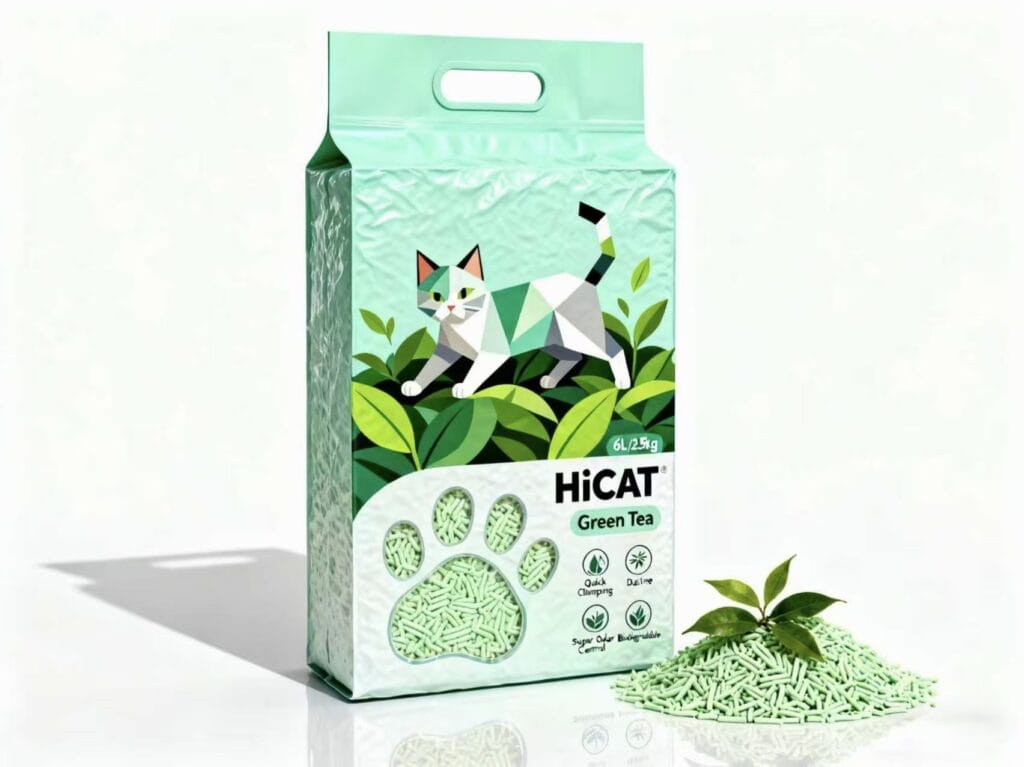
Tofu vs cassava cat litter handles smell differently. Tofu is porous—it soaks up the ammonia. Plus, at QingkePet, we can infuse it. Our Green Tea Tofu Cat Litter is a best-seller because the tea polyphenols naturally neutralize odor.
Cassava, on the other hand, is odorless. It seals the smell inside the hard clump, but the material itself doesn’t have a scent. For customers who want zero fragrance, cassava wins. For those who want a fresh scent, tofu wins.
Biodegradability & Flushability: Which is truly “Toilet Friendly”?
Both fall under the category of biodegradable flushable litter, but the “flush experience” differs.
- Tofu: Dissolves quickly in water. You can watch it break down in seconds.
- Cassava: It swells. While it is flushable, you need to be careful not to dump a huge clump at once, or it might turn into a dumpling in your pipes.
Tofu Cat Litter vs Cassava for Brands: Analyzing Your Profit Margins
Okay, put your CFO hat on. This is the part that actually impacts your bottom line.
Cost Structure: Why Tofu is the Volume King
If you are looking for mass-market penetration, Tofu is your best friend. Why? Scale.
At QingkePet, we have a 50,000-ton annual capacity for Tofu litter. This massive scale allows us to drive raw material costs down. When we talk about tofu cat litter vs cassava for brands, Tofu offers a lower entry price point, allowing you to compete with supermarkets while still keeping a healthy margin.
We can produce standard packaging in 7-10 days. That speed means better cash flow for you.

Premium Positioning: Cassava as the High-End Hero
Cassava raw material (food-grade starch) is more expensive than pea fiber. Period.
However, this allows you to position it as a “Super Premium” product. The retail price of Cassava litter is often 30-50% higher than Tofu.
- Strategy: Use Tofu as your “door opener” product, and Upsell customers to Cassava for higher margins.
- Supply: We dedicate 15,000 tons of capacity to our starch and Corn Cob Cat Litter lines, ensuring stability even for this niche market.

Consumer Loyalty & Repurchase Rates
Finding a low dust cat litter supplier is key here. If the litter is dusty, they won’t buy again.
- Tofu users are loyal because of the price-to-performance ratio.
- Cassava users are loyal because nothing else clumps like it. Once they switch, they rarely go back to clay.
Best Plant Based Cat Litter Comparison 2026: Emerging Trends & Innovations
The market never stands still. If you are just selling plain white tofu litter in 2026, you might be falling behind. Here is what we are seeing in the R&D lab.
The Rise of the “Super Blend”: Private Label Tofu Cassava Blend
This is the secret weapon for 2026. Why choose?
We are seeing a massive spike in requests for a private label tofu cassava blend. Usually, it’s a 70% Tofu / 30% Cassava (or Bentonite) mix.
- The Benefit: You get the absorption of tofu and the rock-hard clumping of cassava.
- The B2B Edge: It’s a unique selling point (USP) that differentiates you from the generic brands on Amazon. We can customize this ratio for you. Check out our OEM & ODM Services to see how we handle these custom mixes.

Beyond the Basics: Bamboo & Health Monitoring Litter
Safety and health are the new frontiers. According to PetMD, monitoring a cat’s urinary health is a top priority for vets.
- Bamboo: Our Bamboo Cat Litter utilizes natural antibacterial properties.
- The Game Changer: Health Monitoring Cat Litter. We have developed a high-end Health Monitoring Cat Litter that changes color to detect pH levels, occult blood, or protein.
Imagine pitching that to your customers: “A litter that tells you if your cat is sick.” That is how you dominate the market in 2026.
Cassava Cat Litter OEM Wholesale: Sourcing Without Headaches
Let’s switch gears from product specs to supply chain reality. You can have the best product in the world, but if your container gets stuck in customs or arrives looking like a dust storm, your brand reputation is toast.
As a consultant, I’ve seen too many brands get burned by “garage factories.” Sourcing cassava cat litter OEM wholesale requires a partner, not just a vendor. Here is what you need to look for to sleep soundly at night.

Identifying a Low Dust Cat Litter Supplier
We talked about dust earlier, but how do you control it at the source?
Many factories cut corners on the de-dusting process to save electricity. Bad idea.
At QingkePet, we operate under strict ISO9001 standards. For both our cassava and tofu lines, we use a 5-step vacuum de-dusting system before the litter ever touches the bag.
- The Litmus Test: Ask your supplier for their “drop test” data. If they hesitate, run.
- Our Standard: We guarantee a 99.5% dust-free rate. This is non-negotiable for high-end markets.
Lead Times Matter: How to Beat the Supply Chain Blues
In 2026, speed is currency.
I recently helped a client in the UK who was facing a stock-out crisis because their previous supplier (inland China) took 45 days just to ship.
We don’t play that game. Because we are located right next to Qingdao Port, our logistics are streamlined:
- Standard Packaging: Ready to ship in 7-10 days.
- Custom OEM Packaging: Ready in 15-20 days.
Case Study: The “Dusty” Rescue Last year, a mid-sized European brand (let’s call them “PetPals”) came to us. They were losing customers because their mixed litter was separating in the bag and creating a cloud of dust upon pouring.
We audited their formula. We switched them to our Private Label Customization process, adjusted the particle density of the cassava to match the tofu (preventing separation), and ran it through our upgraded dedusting line.The Result? Their return rate dropped by 90% in three months, and they just doubled their order volume for Q3 2025.
Private Label Customization: More Than Just a Logo
Your packaging is your silent salesman. We don’t just fill bags; we build brands. Whether you need a 2.5kg vacuum pack for the Japanese market or a 10L jug for the US, our molding team can handle it. We can even customize the pellet diameter (1.5mm, 2.0mm, or broken) to fine-tune that tofu vs cassava cat litter performance.
Final Verdict: Which Should Your Brand Choose?
We’ve covered the chemistry, the costs, and the sourcing. Now, it’s decision time.
There is no “wrong” choice, but there is a “strategic” choice.
The Quick Decision Matrix (Summary Table)
I created this cheat sheet to help you visualize where these products fit in your portfolio.
| Feature | Tofu Cat Litter | Cassava Cat Litter | The “Super Blend” |
| Primary Customer | Eco-conscious, Budget-aware | Performance-focused, Premium | The “Best of Both Worlds” Seeker |
| Clumping Style | Sponge-like, Flushable | Rock-Hard, Instant | Firm & Fast |
| Odor Control | High (Absorbs & Masks) | Medium (Seals) | High |
| Price Tier | Mid-Range ( | Premium ( | Mid-High (−−$) |
| Market Saturation | High (Must differentiate) | Growing (Blue Ocean) | Emerging Trend |
| Sherry’s Pick | Best for Volume Sales | Best for Brand Prestige | Best for Customer Retention |
Let’s Talk Business (CTA)
Navigating the tofu cat litter vs cassava for brands debate doesn’t have to be a solo mission.
You know your customers, and I know the litter.
At QingkePet, we aren’t just trying to sell you a container; we want to help you build a catalog that dominates the SERPs and the shelves. With 50,000 tons of tofu capacity and a growing 15,000-ton line for cassava and Corn Cob Cat Litter, we have the muscle to scale with you.
Ready to see the difference yourself?
Don’t just take my word for it. Let me send you our 2025 Sample Kit, including our new Health Monitoring Cat Litter and the rock-hard Cassava pellets.
Contact Our Team today or drop me a message directly. Let’s get your wholesale cat litter strategy sorted for 2026.
Cheers to cleaner paws and higher profits!

FAQ
1. Is cassava cat litter actually better than tofu for odor control?
It depends on the mechanism you prefer. Cassava cat litter is excellent at physically sealing odors inside its rock-hard clumps because of the high starch content. However, the material itself is odorless. Tofu cat litter, on the other hand, is like a sponge—it absorbs the ammonia. Plus, Tofu is much better at holding natural scents. If your market likes scented options (like our Green Tea Tofu Cat Litter), Tofu wins. If they want unscented performance, Cassava wins.
2. Why is my current tofu litter stock getting moldy in the warehouse?
This is a classic “moisture content” issue from lower-quality suppliers. Tofu and cassava are food-grade materials; if the manufacturer doesn’t dry them properly (below 10-12% moisture) or if the packaging seal fails, mold grows. At QingkePet, we use a high-temperature microwave drying process and standard vacuum packaging to ensure a shelf life of 24 months, even in humid climates.
3. Is it safe if a cat eats tofu or cassava litter?
Yes, this is the biggest selling point over bentonite. Both are plant-based cat litters made from food ingredients (pea fiber, soybean, or tapioca starch). They are non-toxic and digestible in small amounts. However, because they are effectively “carbs,” we don’t recommend letting a cat snack on them as a meal!
4. What is the best ratio for mixing tofu and cassava litter?
Based on our R&D and private label tofu cassava blend orders, the “Golden Ratio” is usually 70% Tofu and 30% Cassava/Bentonite. This combination uses Tofu for absorption and cost-effectiveness, while the 30% Cassava boosts the clumping hardness significantly without skyrocketing the price.
5. Does plant-based litter attract bugs or insects in storage?
It can if not stored correctly, as it is organic material. However, high-quality manufacturing mitigates this. We strip the proteins that bugs love during processing and vacuum seal the bags. For B2B storage, always keep pallets off the ground and in a cool, dry area. If the vacuum seal is intact, bugs cannot get in.
6. How do shipping costs compare between Bentonite, Tofu, and Cassava?
Plant-based cat litter is lighter by volume. A 6L bag of Tofu weighs about 2.5kg, whereas 6L of Bentonite can weigh 4-5kg. This means you can ship significantly more “usage volume” (what the customer actually cares about) per container with Tofu or Cassava than with clay. This drastically improves your unit economics on logistics.
7. Is ‘flushable’ actually safe for old plumbing systems?
Tofu litter is highly water-soluble and generally safe for septic systems if flushed in small amounts. Cassava litter, however, contains high starch which swells when wet. While technically flushable, we advise customers to be more cautious with Cassava. If you are selling to a market with older infrastructure (like parts of Europe), Tofu is the safer recommendation.




 English