
Whether you are a newcomer eager to launch your first pet brand with high hopes, or a veteran deeply rooted in the industry looking to upgrade your product line, this article will serve as your ultimate “desk guide.”
Building a successful Private Label Tofu Cat Litter brand is about more than just slapping a logo on a bag. Today, I want to take you behind the scenes of the supply chain. We will explore comprehensively how to customize a unique formula, how to design packaging that touches hearts using AI, and how to navigate the complexities of global logistics.
Let’s cut through the fog and return to the essence of the product.
1. Back to Basics: What is Premium Soybean Fiber Cat Litter?
To the untrained eye, all tofu cat litter on the market looks somewhat similar. However, for a professional Tofu Cat Litter Manufacturer, the differences are vast. The core differentiation often begins with the raw materials.
The core ingredients of standard tofu cat litter include: Soybean Fiber (or Okara), Corn Starch, and Guar Gum. However, many brand owners confuse “Soybean Fiber” with “Okara” (Bean Dregs). This distinction defines the quality tier of your Soybean Fiber Cat Litter:
1.1 Okara (Bean Dregs)
This is the raw waste or byproduct left over after producing soy products like soy milk or tofu.
- Characteristics: Lower cost, but contains a high level of soy protein and impurities.
- The Downside: If the processing technology is poor, it easily carries a sour “beany” smell (bean stench). Furthermore, due to its high sugar content, it is significantly more prone to growing bugs or molding in humid environments during sea freight.
1.2 Soybean Fiber
This is the premium material obtained after the dregs have been further purified, de-fatted, and de-proteinized.
- Characteristics: Whiter color, tougher structure, and virtually odorless.
- The Advantage: Litter made from pure soybean fiber is more absorbent, the pellets are harder (less dust), and it retains its natural food-grade safety attributes.
As a brand owner, understanding this distinction is your first step in defining your pricing strategy.

2. Quality Control: Insights from a Professional Cat Litter Factory
Before engaging an OEM Cat Litter Supplier, you must learn to scrutinize samples like an expert. In our laboratory, we focus on these critical metrics:
- Moisture Content: This is the line between life and death. If moisture is too high (>12%), it molds easily; if too low (<7%), the pellets become too brittle and crumble into powder. The gold standard is typically controlled at around 8%-10%.
- Dust & Durability: We perform drop tests to simulate transportation. High-quality litter must possess sufficient Hardness to reach the consumer as intact strips. It must also be dust-free when poured to protect the cat’s respiratory tract.
- Absorption & Clumping: Instant absorption is the baseline. The key is whether the clumping is “tight”—it should not scatter when dropped from a height, and it should not stick to the bottom when scooped.
- Deodorization Efficiency: Do not rely solely on fragrance to mask odors. Professional testing focuses on the adsorption rate of Ammonia (urine odor) and Hydrogen Sulfide (feces odor). A compliant product must achieve an efficiency of 90% or higher.

3. Core Strategy: Developing Your Custom Cat Litter Formula
This is the heart of this guide. “Customization” is not simply piling up ingredients; it is a process of solving problems.
First, clarify your Market Positioning and Price Range. Then, research the positive and negative reviews of competitors on Amazon. The complaints you see are the core selling points for your Private Label Tofu Cat Litter.
3.1 Scenario A: Solving “Scent Fades Too Fast”
Customer Feedback: “It smelled great when I first opened the bag, but after a week, the scent was gone, and it even started to stink.”
Root Cause: The manufacturer used cheap surface-spray perfumes, or the fragrance supply chain had poor longevity.
Sherry’s Solution:
In your Custom Cat Litter Formula, you should require the factory to use high-quality oil-based or micro-encapsulated fragrances. We ensure the scent is pure (not pungent for cats) and has slow-release capabilities. Based on a cycle where one bag lasts 3-4 weeks, the scent must remain detectable for over 30 days.
3.2 Scenario B: Solving “Mold and Bugs”
Customer Feedback: “It spent three months at sea and two months in storage. When I opened it, it was unexpectedly moldy!”
Root Cause: Moisture was not controlled well during production.
Sherry’s Solution:
If your target market is in Southeast Asia, the UK, or tropical rainy regions, Water Content Control is the top priority. We recommend strictly controlling the factory exit moisture at 8% ±1%. At the same time, food-grade baking soda or biological enzymes can be added to the Custom Cat Litter Formula, which not only assists in mold prevention but also enhances deodorization.
3.3 Scenario C: Solving “Loose Clumps”
Customer Feedback: “It shatters all over the place when I scoop, and it sticks to the bottom like glue.”
Root Cause: Insufficient Guar Gum or short fibers.
Sherry’s Solution:
Do not cut the budget on Guar Gum. Or, choose a Mixed Cat Litter solution (70% Tofu + 30% Bentonite or Cassava). The small mineral particles fill the gaps in the tofu strips, drastically enhancing wrapping power and clump hardness.
The Bottom Line: Your formula must solve pain points within a price range customers are “willing to pay for.” Contact our expert team to calculate the most cost-effective formula.
4. The Details: Specs for Wholesale Tofu Cat Litter
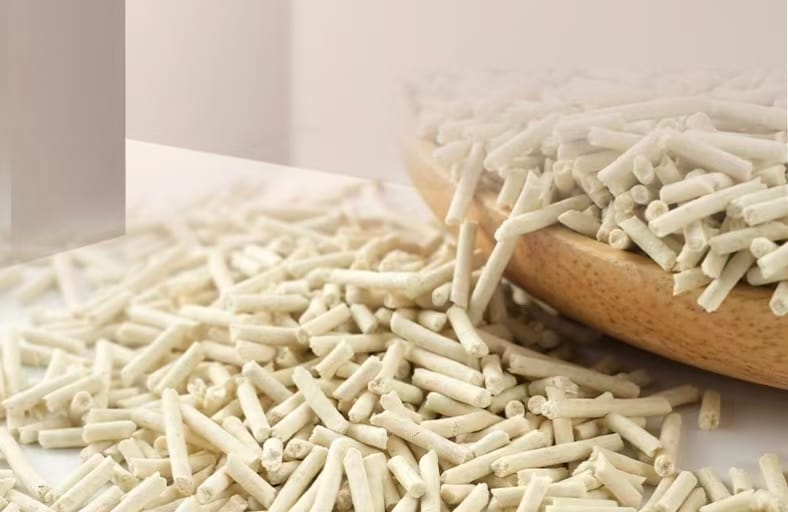
4.1 Size Customization
Many new clients are confused about choosing between 1.5mm and 3.0mm. Here is a comparison table to help you decide on your Wholesale Tofu Cat Litter specs:
| Diameter | Pros | Cons | Recommended Scenario |
|---|---|---|---|
| 1.5mm (Ultra-thin) | Tightest clumps, minimal gaps, extreme wrapping. | Higher tracking (stuck in paws). | For precision-focused owners. |
| 2.0mm (Mainstream) | The Market Gold Standard. Balanced performance. | Average in all aspects. | The ideal standard SKU. |
| 3.0mm (Thick Strip) | Solid paw feel, rarely tracked out. | Looser clumps, higher consumption. | For Long-haired cats. |
4.2 Color & Scent: Emotional Value
In recent years, consumer psychology has shifted from “Functional” to “Emotional.”
- The Natural Trend: Any leading Tofu Cat Litter Manufacturer is exploring “Zero Chemical” natural formulas.
- Localization: Don’t blindly follow trends like Lemon or Lavender. If your market is Southeast Asia, perhaps “Pandan” is preferred; in Japan, “Hinoki Wood” symbolizes luxury. You can send us samples, and we will replicate them. Contact us for scent samples.
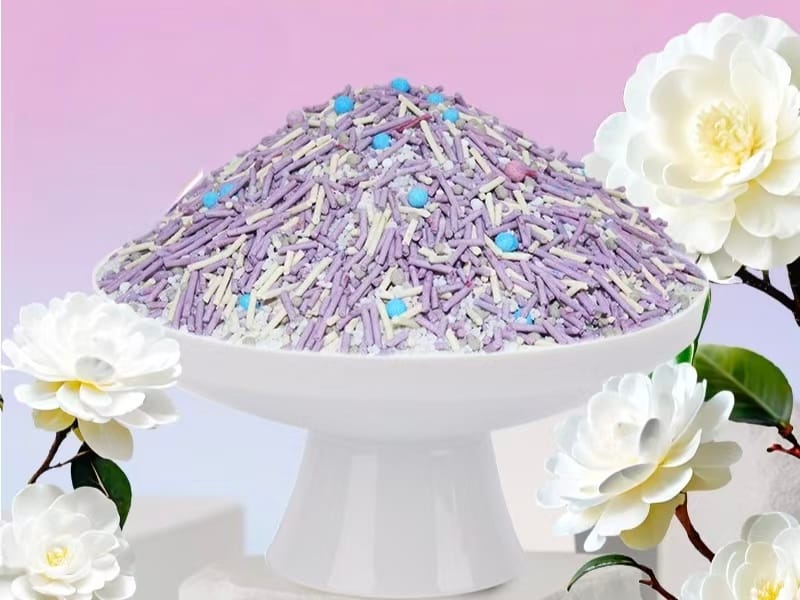
- Healing Series: Scents like White Tea or Sea Salt, combined with Morandi colors, offer a sense of joy, relaxation, and peace to the stressed owner.
In the previous section, we covered product customization. Now, we turn our eyes to the back end—MOQs, Packaging, and Logistics. These determine your cash flow and final profit.
5. The Art of Low MOQ: Balancing Cost and Flexibility
You must be eager to understand the Minimum Order Quantity (MOQ).
5.1 Standard Formula: Low MOQ 3 Tons
If you choose our existing mature formula or have no dyeing requirements, the MOQ is 3 Tons.
- Why 3 Tons? This is primarily a logistics consideration. If the volume is too small (e.g., 1 ton), the inland trucking and port fees amortized per bag become astronomically high, leaving you with no price competitiveness.
5.2 Custom Color & Scent: MOQ 5 Tons
If you want unique “Sakura Pink” or “Custom White Tea,” the MOQ is 5 Tons.
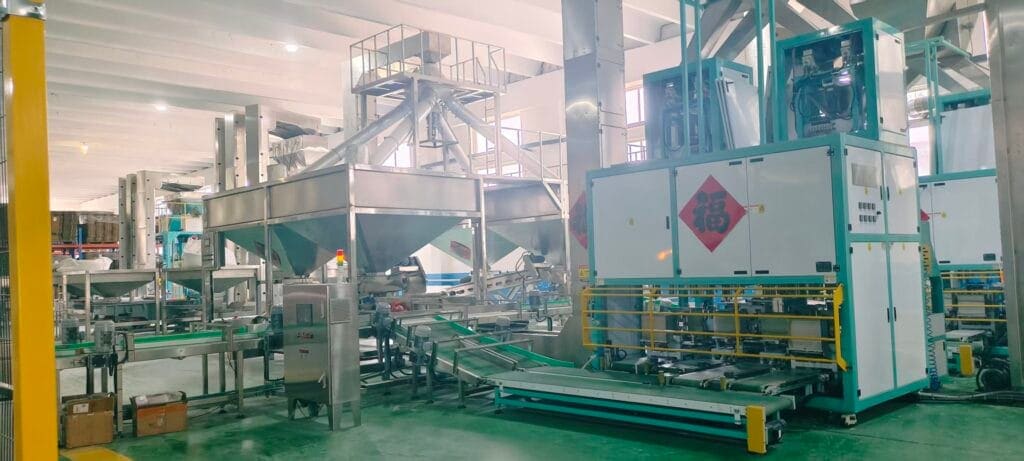
- Why not 1 Ton? This involves the production logic of a Cat Litter Factory. For a busy factory, lines run 24/7.
- The Cost of Change: To produce your custom color, we must stop the machine for 2-3 hours to deep clean the entire line. This ensures the next order doesn’t have cross-contamination (mixed colors). For most factories, this downtime cost is too high for a small order.
6. Cat Litter Packaging Design: Brand Strategy in the AI Era
Once the formula is set, it needs a “beautiful outfit.”
6.1 Leverage AI Tools to Break Design Bottlenecks
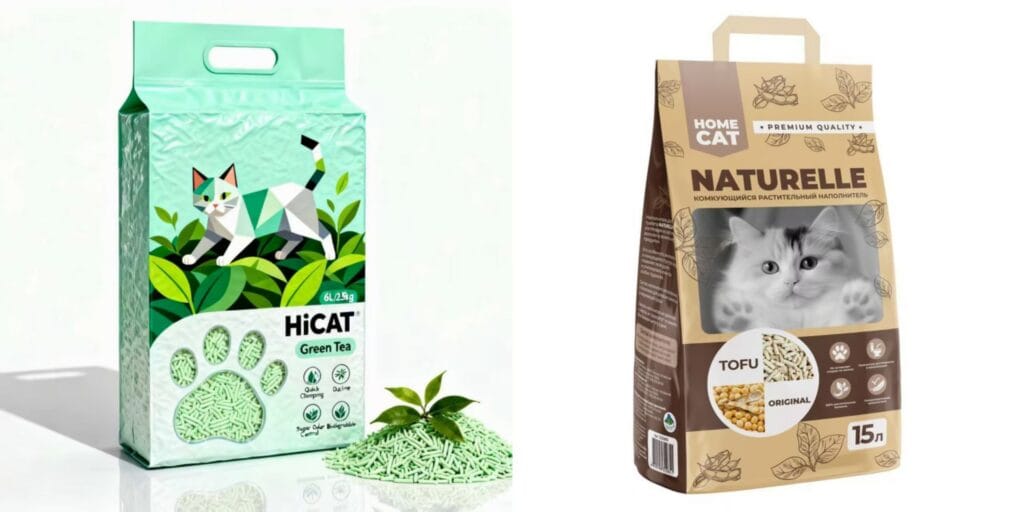
In the AI era, you don’t need to spend a fortune on trial and error. You can use tools like Midjourney, DALL-E, Nano Banana, or Lovart to quickly generate brand visual strategies.
If you don’t know what you want, the designer can only give you generic packaging. You must become the director; AI is your concept artist.
Actionable Tip: How to Write High-Quality AI Prompts?
Try uploading your LOGO and inputting this structure to generate professional concepts:
[Role Setting]: You are a Red Dot Award-winning packaging designer.
[Task]: Design a plastic packaging bag for a light beige, white tea scented Tofu Cat Litter. Brand name “PurrPure” (Logo uploaded). Product highlights: “Natural White Tea” and “Super Deodorizing”.
[Style]: Minimalist, Morandi Green tone, embodying healing, relaxation, and eco-friendliness.
[Visual Details]: Center image is a hand-drawn style white cat, stretching comfortably. Texture: Matte finish.
[Output]: Generate 3 different 3D renderings, soft lighting, front view.
Take the AI image you like best to our Cat Litter Packaging Design team. Communication efficiency will improve 10x.

6.2 Packaging Philosophy
- Southeast Asia: Preference for High-strength woven bags. Durability and sealing are king.
- USA/Europe: Sustainability is crucial. “Recyclable” or “Biodegradable” marks add immense brand value.
7. Logistics Victory: How to Import Cat Litter Safely
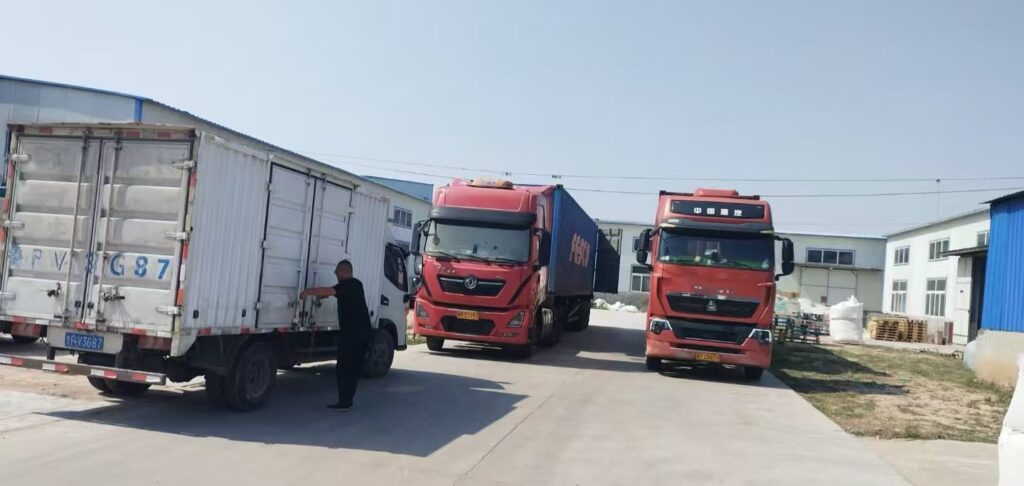
Logistics is the bloodstream of cross-border trade. Whether you are a startup or a mature brand, we offer professional support.
7.1 For Established Brands (FOB/CIF)
For veteran buyers who frequently import from China, you likely have a stable supply chain. For you, the value of an OEM Cat Litter Supplier lies in “Precision Coordination”: perfect documentation (MSDS, COA) and optimizing container loading to squeeze out profit.
7.2 For Startups: Logistics Determines Success
For new importers or individual entrepreneurs, logistics can be a deal-breaker. We offer Door-to-Door services, but you must choose between DDU and DDP.
Core Knowledge: DDU vs. DDP
- DDU (Delivered Duty Unpaid):
- Process: We ship to your door, but you handle import duties and VAT.
- The Hurdle: To get a valid Proof of Tax Payment (Tax Receipt), you typically need a registered local company and an Import License. In the US and Europe, selling legally often requires these documents.
- DDP (Delivered Duty Paid):
- Process: The “Hassle-Free” King. We handle shipping, customs, and taxes. You just wait for the delivery.
- The Cost Truth: DDP is convenient but expensive—often 2-3 times standard sea freight.
- Why Choose It? If you are an individual without a license, it is the only safe way to Import Cat Litter DDP.
7.3 Sincere Advice for Entrepreneurs
Capital is precious. But I suggest: Do not risk your goods to save on logistics.
- If you have a company and license, boldly choose FOB or DDU to save costs and get tax deductions.
- If you are testing the waters individually, strictly choose DDP. Although it compresses early margins, it guarantees 100% safety.
Remember: In the startup phase, “Acquiring loyal customers” and “Running the model” are more important than “High Margins.” Once volume stabilizes, register your company and switch to FOB. This is the path of growth.
8. Conclusion: Finding the Right Partner
Building a brand is a marathon, not a sprint.
From refining the Custom Cat Litter Formula to the emotional value of packaging, and finally to the logistics game, every step is challenging. At this moment, having a Tofu Cat Litter Manufacturer who is willing to patiently listen and grow with you from “small orders” is your greatest asset.
We don’t just sell litter; we output a complete brand incubation solution.
I am Sherry. If you love the pet industry and are determined to build a unique Private Label Tofu Cat Litter brand, no matter what stage you are at, I welcome you to chat. Let’s use professionalism and sincerity to move those picky yet adorable cat owners.

People Also Ask (FAQ)
1. What is the minimum order quantity (MOQ) for private label tofu cat litter?
For our standard formulas, the MOQ is 3 tons to ensure logistics efficiency. If you require a Custom Cat Litter Formula, specific colors, or unique scents, the MOQ increases to 5 tons. This is because customizing colors requires the Cat Litter Factory to stop production for 2-3 hours to clean the entire line, preventing cross-contamination.
2. Can you replicate a specific scent for my local market?
Yes. As a top OEM Cat Litter Supplier, we specialize in localization. We advise against blindly following global trends. If your local market prefers scents like “Pandan” (SE Asia) or “Hinoki” (Japan), send us a physical sample. Our R&D team will reverse-engineer it for your Wholesale Tofu Cat Litter orders.
3. What is the difference between DDP and DDU shipping?
DDP (Delivered Duty Paid) means the supplier handles everything: shipping, customs, and taxes. It is best for those looking to Import Cat Litter DDP without licenses. DDU (Delivered Duty Unpaid) means you are responsible for import duties. Choose DDU only if you have a registered company to receive valid tax receipts.
4. Why should I choose Soybean Fiber over Okara?
Soybean Fiber is the premium choice—whiter, harder, and odorless. Okara (Bean Dregs) is cheaper but contains high sugar/protein, leading to sour smells or bug infestations during shipping. For a premium Private Label Tofu Cat Litter brand, always ask for Soybean Fiber.
5. Do you offer eco-friendly packaging?
Yes. We offer Recyclable (PE/PE) and Biodegradable packaging. Our Cat Litter Packaging Design team can help you create sustainable packaging that appeals to US and European markets.
6. How do I ensure my tofu litter doesn’t get moldy?
We strictly control moisture to 8% ±1% at the factory. For humid regions, we add baking soda or enzymes to the formula and use desiccants in shipping containers to withstand months at sea.
7. Can I mix tofu litter with other types?
Yes. We offer Mixed Cat Litter solutions (e.g., 70% Tofu + 30% Bentonite). The small particles fill voids for tighter clumping. Contact us to request a mixed sample.



 English